|
|
|

|
|
|
|
|
|
|
|
|
|
|
|
|
|
Retired March 1, 1983
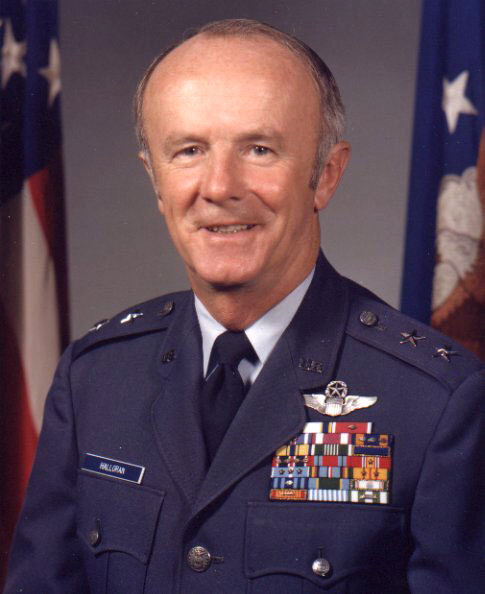
Maj. Gen. Patrick J. Halloran's last Air Force assignment was Deputy Director for Strategic Command, Control and Communications Systems, Command, Control and Communications Systems Directorate, Joint Staff, Organization of the Joint Chiefs of Staff, Washington, D.C.
General Halloran was born in 1928, in Chatfield, Minn. He graduated from Chatfield High School in 1946 and attended MacPhail College of Music in Minneapolis until 1949. While in the Air Force, General Halloran received his bachelor of arts degree in social science from Troy (Ala.) State University in 1971. He is also a graduate of the Air War College, Maxwell Air Force Base, Ala.
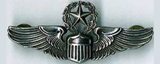
He entered the Air Force in August 1949 and earned his pilot wings and commission through the aviation cadet program, graduating at Williams Air Force Base, Ariz., in September 1950. His first assignment was with the 31st Fighter-Escort Wing of Turner Air Force Base, Ga. In January 1952 General Halloran transferred to the 136th Fighter-Bomber Wing, K-2 Field, South Korea. He flew 100 combat missions in F-84s. He was assigned to the 506th Strategic Fighter Wing, Dow Air Force Base, Maine, in January 1953 and remained with that unit when it moved to Tinker Air Force Base, Okla., in March 1955.
In June 1957 General Halloran was assigned to the U-2 program with the 4028th Strategic Reconnaissance Squadron at Laughlin Air Force Base, Texas. He moved with the 4028th from Laughlin to Davis-Monthan Air Force Base, Ariz., in April 1963, where he first was squadron operations officer and then squadron deputy commander.
During his years with the U-2 program, General Halloran flew missions from nearly a dozen forward operating locations overseas and accumulated more than 1,600 flying hours in the high-flying reconnaissance aircraft.
In December 1965 General Halloran was assigned to Beale Air Force Base, Calif., and become one of the first pilots in the SR-71 reconnaissance aircraft. In 1969 General Halloran was appointed commander of the 1st Strategic Reconnaissance Squadron. He later served as deputy director of operations for the 9th Strategic Reconnaissance Wing.
General Halloran completed the Air War College in June 1971 as a distinguished graduate. He next was assigned as chief of the Reconnaissance Operations Division at Headquarters Strategic Air Command, Offutt Air Force Base, Neb.
In July 1972 General Halloran returned to Beale Air Force Base as vice commander of the 9th Strategic Reconnaissance Wing and in May 1973 became commander. He moved to Andersen Air Force Base, Guam, in July 1975 and served as vice commander of 3rd Air Division until July 1976, when he became chief of staff, Fifteenth Air Force, at March Air Force Base, Calif. In June 1977 he was assigned as SAC inspector general and in May 1979 became the command's assistant deputy chief of staff for operations. He assumed his JCS duties in June 1980.
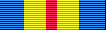
He is a command pilot with more than 8,000 military flying hours, including 600 hours in the SR-71. He has over 11,000 hours total flying time. Among General Halloran's military decorations and awards are the Defense Distinguished Service Medal, Distinguished Service Medal, Legion of Merit with oak leaf cluster, Distinguished Flying Cross with oak leaf cluster, Meritorious Service Medal, Air Medal with 11 oak leaf clusters, Air Force Commendation Medal and Army Commendation Medal.
He lives in Colorado Springs, Colorado, owns a Lancair experimental aircraft and is actively involved in EAA sport aviation. He is also the lead pilot on the only replica of the famous 1934 British deHavilland Comet racing airplane, which is maintained in California.
 |
 |
 |